

Terms Used In Forex Trading
Forex Trading Terminology
 The Forex market comes with its very own set of terms and jargon. And then, earlier you lot go any deeper into learning how to trade the Fx marketplace, it'due south important you sympathise some of the bones Forex terminology that you will encounter on your trading journey…
• Basic Forex terms:
Cross rate – The currency exchange rate betwixt ii currencies, both of which are non the official currencies of the country in which the commutation rate quote is given in. This phrase is also sometimes used to refer to currency quotes which exercise not involve the U.S. dollar, regardless of which country the quote is provided in.
For example, if an exchange rate between the British pound and the Japanese yen was quoted in an American newspaper, this would be considered a cross rate in this context, because neither the pound or the yen is the standard currency of the U.Southward. However, if the exchange rate between the pound and the U.S. dollar were quoted in that same newspaper, it would non be considered a cross rate because the quote involves the U.S. official currency.
Substitution Rate – The value of 1 currency expressed in terms of another. For case, if EUR/USD is 1.3200, 1 Euro is worth Us$1.3200.
Pip – The smallest increase of price motion a currency tin make. Also chosen point or points. For example, one pip for the EUR/USD = 0.0001 and i pip for the USD/JPY = 0.01.
Leverage – Leverage is the ability to gear your business relationship into a position greater than your total account margin. For case, if a trader has $1,000 of margin in his business relationship and he opens a $100,000 position, he leverages his acc ount by 100 times, or 100:1. If he opens a $200,000 position with $ane,000 of margin in his account, his leverage is 200 times, or 200:1. Increasing your leverage magnifies both gains and losses.
To calculate the leverage used, divide the total value of your open up positions past the total margin rest in your account. For example, if you have $10,000 of margin in your account and you lot open one standard lot of USD/JPY (100,000 units of the base currency) for $100,000, your leverage ratio is 10:i ($100,000 / $10,000). If you open 1 standard lot of EUR/USD for $150,000 (100,000 x EURUSD 1.5000) your leverage ratio is 15:1 ($150,000 / $10,000).
Margin – The eolith required to open or maintain a position. Margin can be either "free" or "used". Used margin is that amount which is being used to maintain an open up position, whereas free margin is the amount available to open new positions. With a $1,000 margin balance in your account and a 1% margin requirement to open a position, you can buy or sell a position worth up to a notional $100,000. This allows a trader to leverage his account by upward to 100 times or a leverage ratio of 100:1.
If a trader's account falls below the minimum corporeality required to maintain an open position, he volition receive a "margin call" requiring him to either add together more money into his or her account or to close the open up position. Most brokers volition automatically close a trade when the margin residual falls below the amount required to keep it open. The amount required to maintain an open position is dependent on the banker and could be 50% of the original margin required to open the trade.
Spread – The divergence between the sell quote and the buy quote or the bid and offering cost. For instance, if EUR/USD quotes read 1.3200/03, the spread is the difference between 1.3200 and 1.3203, or 3 pips. In order to interruption even on a trade, a position must motion in the direction of the trade past an amount equal to the spread.
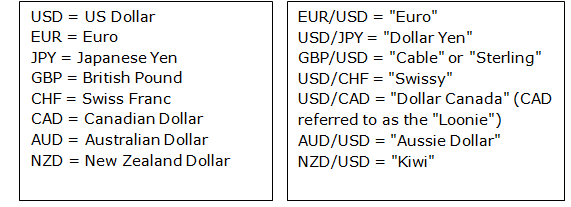
• The major Forex pairs and their nicknames:
• Understanding Forex currency pair quotes:
You will demand to empathize how to properly read a currency pair quote earlier you start trading them. So, let's get started with this:
The substitution rate of two currencies is quoted in a pair, such as the EURUSD or the USDJPY. The reason for this is because in whatever foreign substitution transaction y'all are simultaneously ownership i currency and selling another. If you were to buy the EURUSD and the euro strengthened against the dollar, you would then be in a assisting merchandise. Hither's an example of a Forex quote for the euro vs. the U.South. dollar:
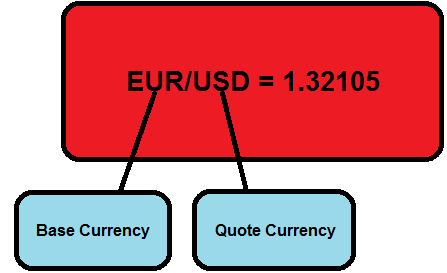
The first currency in the pair that is located to the left of the slash marker is called the base currency, and the second currency of the pair that's located to the right of the slash market place is chosen the counter or quote currency.
If you lot purchase the EUR/USD (or whatsoever other currency pair), the commutation rate tells yous how much you need to pay in terms of the quote currency to buy i unit of the base currency. In other words, in the example in a higher place, you have to pay 1.32105 U.S. dollars to buy 1 euro.
If yous sell the EUR/USD (or any other currency pair), the commutation rate tells you how much of the quote currency you receive for selling ane unit of the base currency. In other words, in the example in a higher place, you will receive one.32105 U.Southward. dollars if you sell one euro.
An easy way to remember about information technology is similar this: the BASE currency is the BASIS for the trade. So, if you buy the EURUSD you are buying euro'southward (base currency) and selling dollars (quote currency), if you sell the EURUSD you are selling euro's (base currency) and buying dollars (quote currency). So, whether you buy or sell a currency pair, it is always based upon the first currency in the pair; the base currency.
The basic point of Forex trading is to buy a currency pair if y'all call back its base of operations currency will appreciate (increase in value) relative to the quote currency. If you think the base of operations currency will depreciate (lose value) relative to the quote currency you lot would sell the pair.
• Bid and Ask price
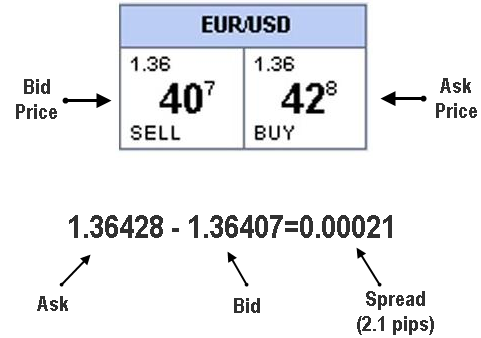 Bid Cost – The bid is the cost at which the market (or your broker) will purchase a specific currency pair from you lot. Thus, at the bid price, a trader tin sell the base currency to their broker.
Enquire Price – The ask toll is the cost at which the market place (or your broker) will sell a specific currency pair to you. Thus, at the inquire price you can buy the base currency from your broker.
Bid/Ask Spread – The spread of a currency pair varies between brokers and it is the departure between the bid and ask the cost.
Jump To Next Chapter – Part three: Long or Short ? Club Types And Computing Profits & Losses
Jump Dorsum To Get-go – Forex Trading Beginners University
Syllabus Of All Capacity
Office one: Introduction – What Is Forex Trading ?
Function ii: Forex Trading Terminology
Part three: Long or Short ? Order Types And Computing Profits & Losses
Part 4: What is Professional person Forex Trading?
Function v: What is Fundamental Analysis?
Office 6: What is Price Action Trading Analysis?
Part 7: Introduction to Forex Charting
Office 8: What Is A Forex Trading Strategy?
Office ix: Mutual Forex trading mistakes and traps
Part 10: What is Technical Analysis
Function 11: How to Make a Forex Trading Plan
Role 12: The Psychology of Forex Trading
Role thirteen: Professional Price Action Forex Trading Strategies

May Special: Become xl% Off Nial Fuller'due south Professional Trading Course, Daily Merchandise Ideas Newsletter & Members Chat Room. Ends May 31st - Learn More Here

Nial Fuller
About Nial Fuller
is a Professional person Trader, Investor & Author who is considered 'The Authority' on Price Activeness Trading. His blog is read by over 200,000+ followers and he has taught 25,000+ students since 2008. In 2016, Nial won the Million Dollar Trader Competition. Checkout Nial's Professional Trading Course here.


Terms Used In Forex Trading,
Source: https://www.learntotradethemarket.com/forex-university/forex-trading-terminology
Posted by: bourgeoisbehiden.blogspot.com
0 Response to "Terms Used In Forex Trading"
Post a Comment