

Forex Pairs That Trend Best
Contents
- Currency pairs
- Methodology
- Calculations
- Rate of change
- Volatility
- Consecutive closing above/below moving average
- Higher Loftier + Higher Depression and Lower Low + Lower High
- Consecutive bullish/bearish candles
- Conclusions
- Script
The present guide provides an updated review of the near trending currency pairs in 2021. Additionally, it too provides a script that yous can apply to calculate trend statistics for any set up of trading instruments and timeframes.
Measuring a trendedness of a currency pair (or any other trading instrument) is ever a challenge. It is accentuated past the problem of this trendedness irresolute over time. A currency pair might be trending strongly one year and be completely trendless the side by side twelvemonth. Notwithstanding, it is possible (and important if you trade the tendency) to compare the trendedness of currency pairs based on a set of metrics to get a better understanding of which currency pairs trend the most and too how exactly they trend.
The postal service below analyzes x currency pairs based on five metrics. It explains how these metrics piece of work and why they tin can serve every bit a rough proxy of a pair'southward trendedness.
Currency pairs
For the analysis, we chose ten currency pairs that 3 conditions: they are very liquid (according to the 2019 Triennial Central Bank Survey), they accept low spreads, they are readily available at retail Forex brokers. For instance, the rather liquid USD/CNY currency pair is omitted (which is the sixth nearly liquid in the world) because it is available only at few brokers, its spreads are high, and trading is severely restricted past the People'south Banking company of Prc. Instead, we volition expect at the post-obit currency pairs for this written report (presented in alphabetical order):
- AUD/USD
- EUR/GBP
- EUR/JPY
- EUR/USD
- GBP/JPY
- GBP/USD
- NZD/USD
- USD/CAD
- USD/CHF
- USD/JPY
Methodology
We use the following methods to assess the trendedness of the currency pairs:
- Mean and median rate of alter.
- Mean and median volatility.
- Boilerplate and median number of sequent closes above/beneath a 50-period simple and exponential moving averages.
- Hateful number of consecutive Higher High + Higher Low or Lower Low + Depression High occurrences.
- Hateful number of consecutive bullish or consecutive bearish candles.
Charge per unit of change is calculated as previous Shut minus current Close and divided by previous Close to get the percentage value. Obviously, this is a crude method of analysis. However, information technology can requite us some hints on the pairs that trend oft.
Currency pair's volatility is calculated as candle'due south High minus Low divided past its Open. It is calculated in percentage points as well.
The higher up calculation would be only a starting point. To identify the best of the trending currency pairs, we need to summate precisely the number of periods a pair had been in a tendency during some span of fourth dimension. We need a dependable indicator to identify tendency in three different timeframes. We apply moving average for that purpose. We calculate themean and median number of consecutive closes above/beneath the moving average. By ranking the boilerplate of the number of closes above/below a moving average, we tin get additional insights regarding how trending the pairs are. Beginners are often advised to use an exponential moving average instead of a simple one every bit the former lags less (i.due east. it follows a trend more quickly). We verify that as well by applying the calculations to both uncomplicated and exponential 50-period moving averages.
Sequent Higher Loftier + Higher Depression or Lower Depression + Lower High testify exactly that — the streaks of bars that are formed co-ordinate to one of the most popular definitions of trend.
Consecutive bullish and surly candles show how probable is a bearish candle is to exist followed past other bearish candles and the same for bullish ones.
All calculations are repeated on three timeframes: daily, weekly, and monthly. All currency pairs are analyzed using the data of v years back from May 21, 2021. The data is derived from MetaTrader v platform with a server in GMT+2 time zone, which means that the weekly session goes from Mon 00:00 to Friday 23:59.
Calculations
Rate of change
Nosotros can calculate the absolute change in the exchange rate of a currency pair in a given period (twenty-four hour period, week, calendar month), using the following formula:


where Northward is the full number of periods.
The median rate of change is calculated past sorting the individual rates of changes (Tn) and either picking the heart ane (for odd number) or calculating the mean of the 2
We have to use the percentage values because the direct (pips) rate of change would differ significantly amidst currency pairs as their substitution rates are not comparable.
The tabular array provides the 5-year mean and median percentage (%) rate of change values for the studied currency pairs for three timeframes from May 22, 2016, until today.
| Currency pair | Daily | Weekly | Monthly | |||
| Mean | Median | Mean | Median | Mean | Median | |
| AUD/USD | 0.44 | 0.35 | 1.00 | 0.78 | 2.32 | two.10 |
| EUR/GBP | 0.37 | 0.27 | 0.83 | 0.63 | i.42 | 0.85 |
| EUR/JPY | 0.37 | 0.28 | 0.86 | 0.70 | i.57 | 1.33 |
| EUR/USD | 0.34 | 0.28 | 0.78 | 0.62 | one.47 | one.23 |
| GBP/JPY | 0.49 | 0.37 | one.25 | 0.92 | 2.26 | i.87 |
| GBP/USD | 0.44 | 0.34 | 1.08 | 0.88 | 1.79 | 1.50 |
| NZD/USD | 0.46 | 0.37 | 1.12 | 0.96 | 2.34 | 2.46 |
| USD/CAD | 0.33 | 0.25 | 0.75 | 0.threescore | 1.48 | one.09 |
| USD/CHF | 0.32 | 0.25 | 0.78 | 0.65 | 1.fifty | 1.22 |
| USD/JPY | 0.37 | 0.27 | 0.93 | 0.70 | 1.83 | 1.26 |
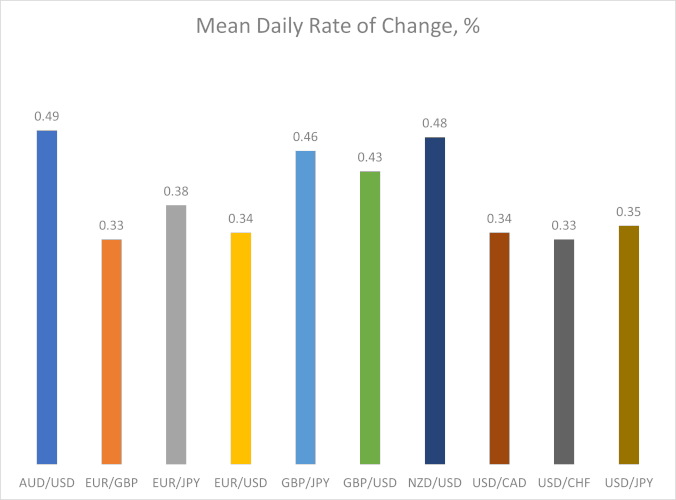
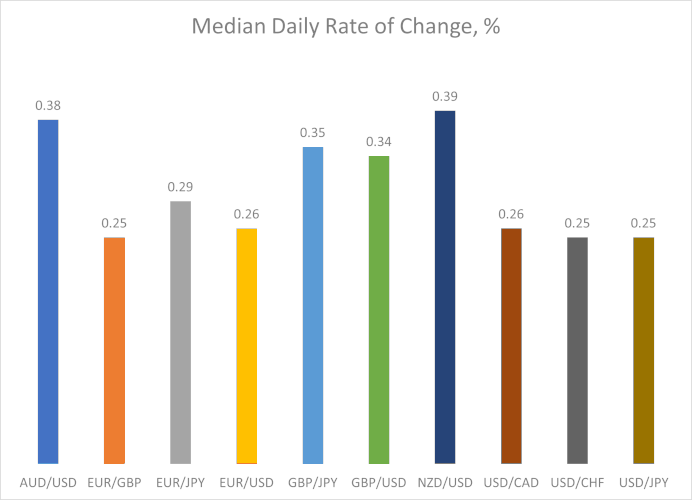
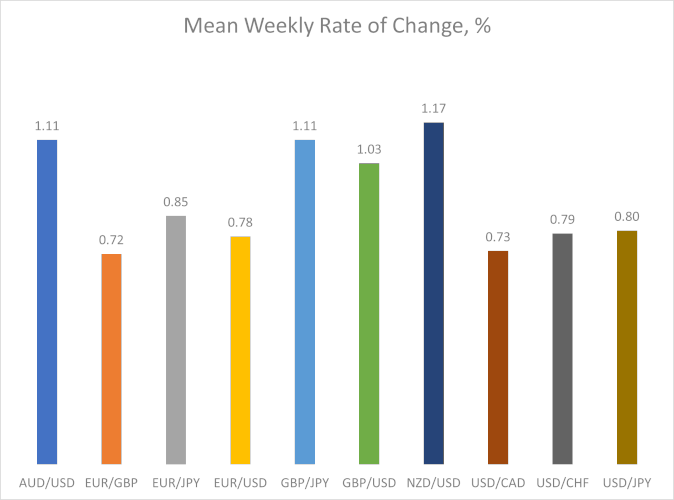
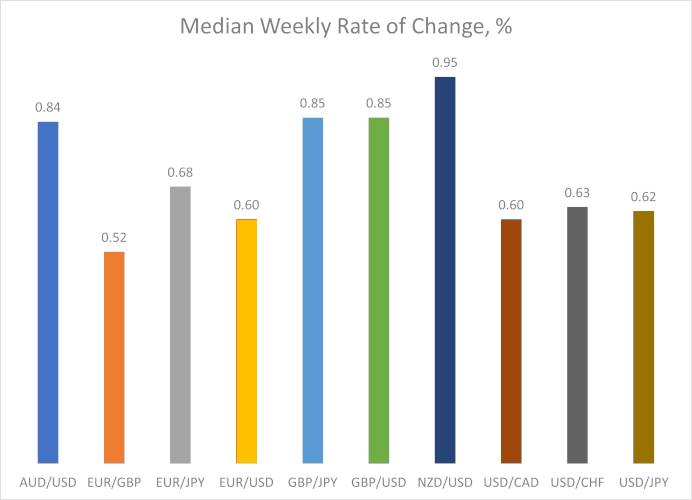
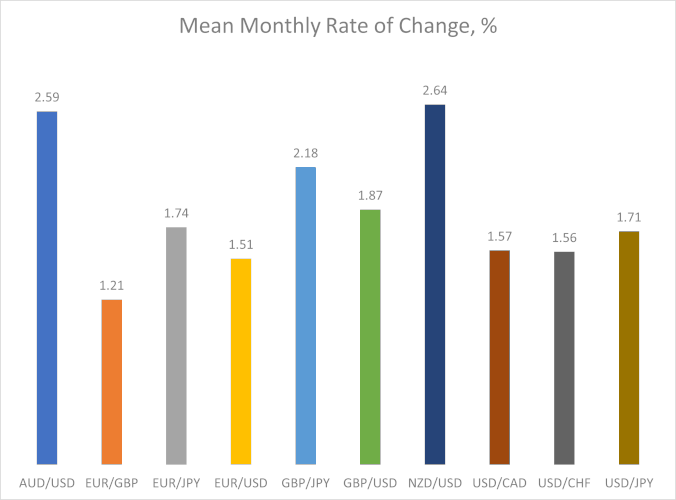
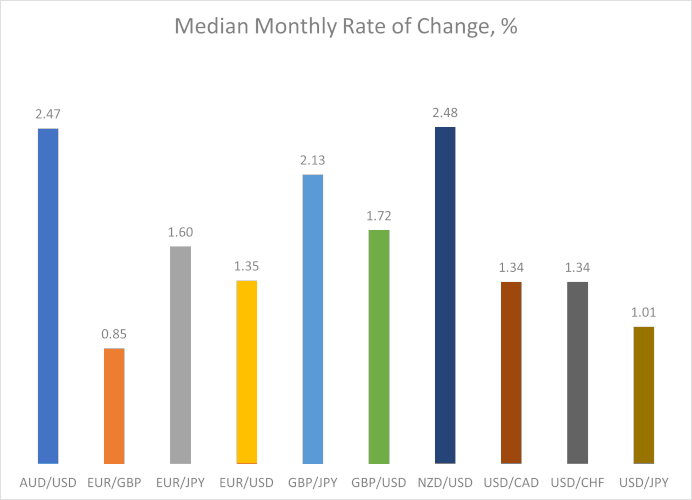
The table above shows how mean and median changes (per day, per calendar week, and per month) differ among currency pairs. The first noticeable matter is that they don't vary past a lot — there isn't a case where one currency would bear witness twice the average modify of the other. Permit's look at the charts below to meliorate analyze the differences among the currency pairs' boilerplate change for the period.
Unlike in the previous year, at that place was no articulate winner across all timeframes this year. Judging past the hateful modify, GBP/JPY demonstrated the biggest daily and weekly charge per unit of change just was only the tertiary on the monthly timeframe, coming backside NZD/USD and AUD/USD. Equally for the median modify, the clear winner was NZD/USD, though its daily 0.37% rate of change was the same every bit for GBP/JPY. Every bit for the
Volatility
The volatility of a currency pair can be calculated using the formula:


where North is the total number of periods.
The median volatility is calculated by sorting the individual volatility values (Vn) and either picking the center ane (for odd N) or calculating the mean of the two
The table summarizes the mean and median percentage (%) volatility values of the studied currency pairs for daily, weekly, and monthly timeframes from May 22, 2016, till May 21, 2021.
| Currency pair | Daily | Weekly | Monthly | |||
| Mean | Median | Mean | Median | Mean | Median | |
| AUD/USD | 0.xc | 0.79 | 2.06 | i.86 | 4.38 | 3.75 |
| EUR/GBP | 0.77 | 0.67 | 1.72 | 1.51 | 3.46 | three.17 |
| EUR/JPY | 0.77 | 0.68 | 1.76 | 1.57 | 3.38 | 3.03 |
| EUR/USD | 0.67 | 0.63 | one.54 | 1.40 | iii.15 | 2.86 |
| GBP/JPY | 1.02 | 0.86 | 2.38 | 1.91 | 4.98 | 4.53 |
| GBP/USD | 0.89 | 0.77 | ii.06 | 1.77 | 4.25 | 3.88 |
| NZD/USD | 0.94 | 0.84 | 2.17 | ane.94 | 4.45 | 4.12 |
| USD/CAD | 0.67 | 0.60 | ane.52 | 1.40 | iii.01 | 2.95 |
| USD/CHF | 0.66 | 0.60 | 1.52 | ane.37 | iii.04 | ii.84 |
| USD/JPY | 0.71 | 0.61 | i.67 | 1.44 | 3.42 | 2.99 |
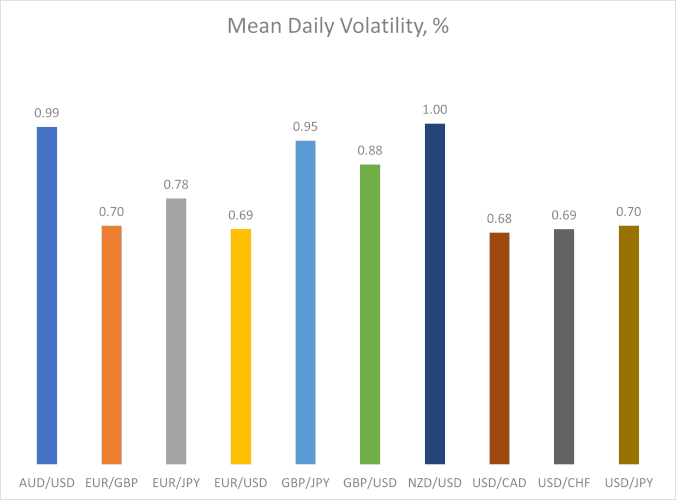
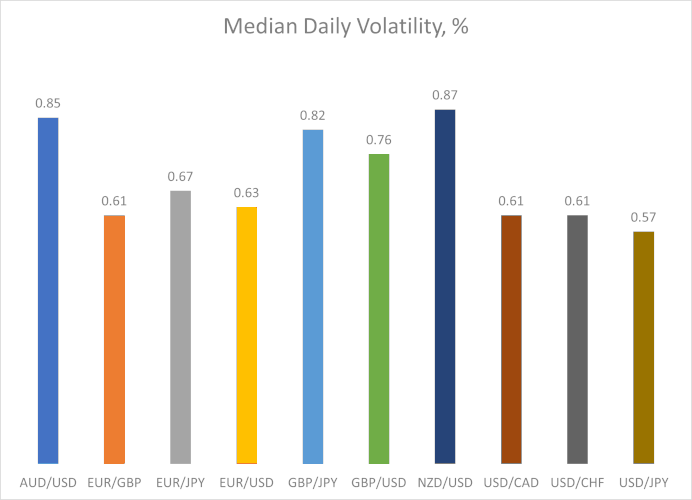
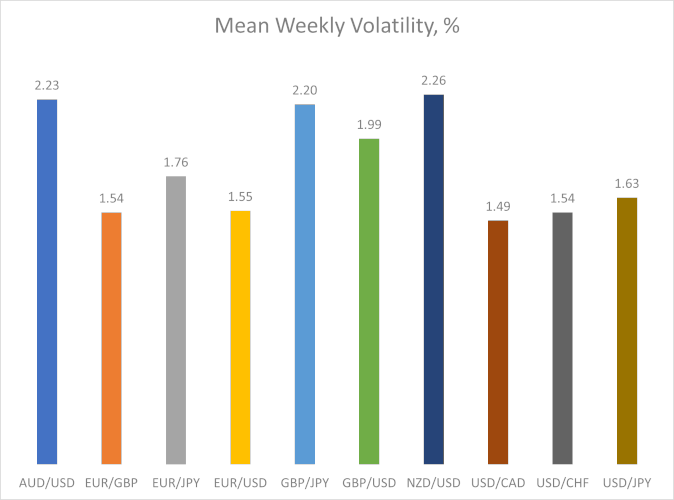
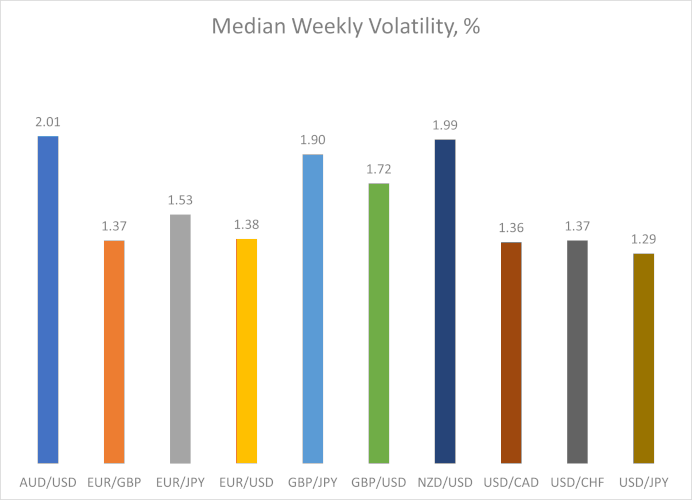
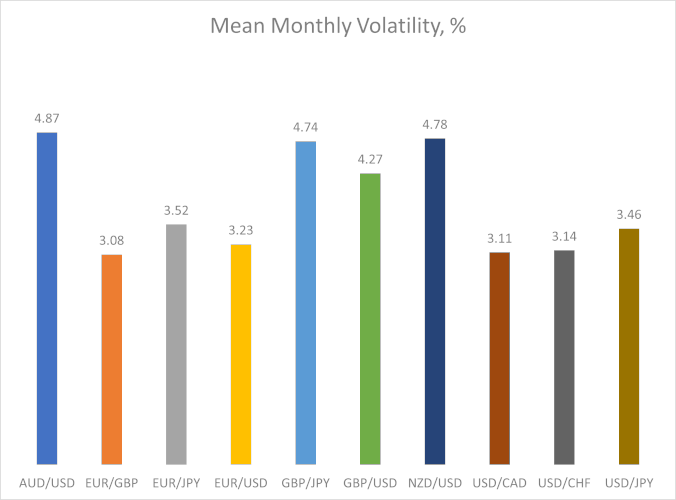
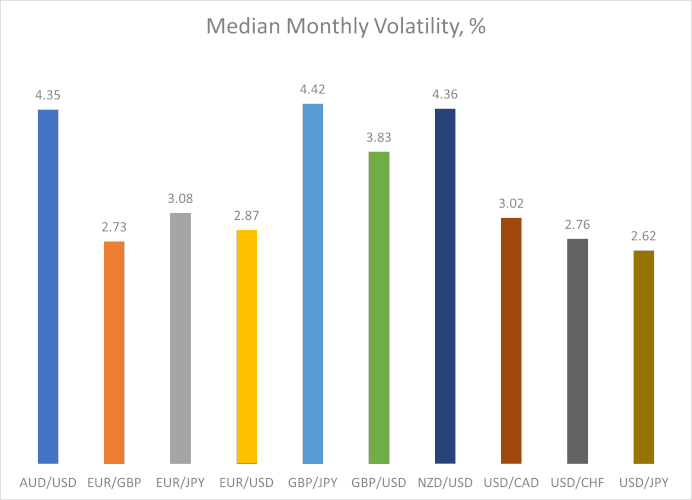
As y'all can encounter, the mean and median volatility of the studied currency pairs varies even less than the charge per unit of change. Unsurprisingly, the most volatile currency pair turns out to exist GBP/JPY, which was also the near trending pair equally measured higher up using the hateful charge per unit of change. Beneath, yous tin can detect half dozen charts that illustrate and assist to compare the differences in volatility for the studied currency pairs.
GBP/JPY is leading in volatility across all timeframes except when measured past median weekly volatility (where in that location is NZD/USD at ane.94%). NZD/USD ends upwards second across all three timeframes in both hateful and median measures, except for the median weekly chart. USD/CAD and USD/CHF were the least volatile pairs by all measures on almost all timeframes, though EUR/USD was shut, existence the second least volatile pair by the median measure on the monthly timeframe.
Consecutive closing above/below moving average
One of the most intuitive methods to detect Forex trends is to use a moving average. Nosotros calculate the mean and median number of consecutive closes to a higher place and below a l-catamenia (daily, weekly, and monthly) moving average (both simple and exponential).
| Daily | ||||
| Currency pair | SMA | EMA | ||
| Mean | Median | Mean | Median | |
| AUD/USD | 13.5 | five.0 | ten.3 | 3.0 |
| EUR/GBP | 10.8 | 3.0 | 9.9 | 3.0 |
| EUR/JPY | 13.ix | 4.0 | 10.7 | three.0 |
| EUR/USD | 8.9 | 3.0 | x.0 | 4.0 |
| GBP/JPY | fifteen.six | vii.0 | eleven.four | 2.5 |
| GBP/USD | 12.8 | 4.0 | x.7 | iii.0 |
| NZD/USD | 15.three | 4.0 | 12.8 | iv.0 |
| USD/CAD | 12.8 | 5.0 | 10.0 | 3.0 |
| USD/CHF | 10.nine | 5.0 | 9.seven | 4.0 |
| USD/JPY | 10.7 | 4.0 | x.five | 3.5 |
Unlike previous measures of trendedness, consecutive closes beneath or above moving averages seem to result in more pregnant differences between the pairs. For case, when compared to the SMA, the median number for GBP/JPY pair is 7.0 periods, while it is only 3 for such pairs equally EUR/GBP and EUR/USD. This ways that GBP/JPY tends to stay more than twice longer above or below a moving boilerplate compared to those pairs. The comparison of other pairs is well illustrated by the charts beneath.
One notable takeaway is the pb of NZD/USD and GBP/JPY among mean consecutive days above/below EMA. EUR/USD, NZD/USD, and USD/CHF lead with the highest median value of consecutive days above/beneath EMA where, surprisingly, GBP/JPY is the pair with the minimum median value of such days.
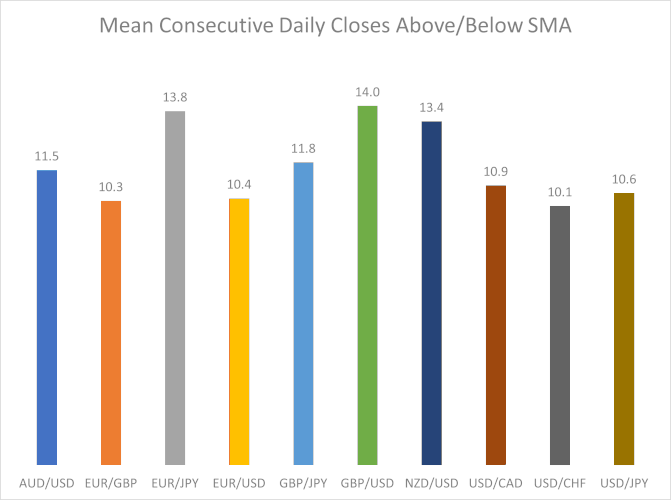
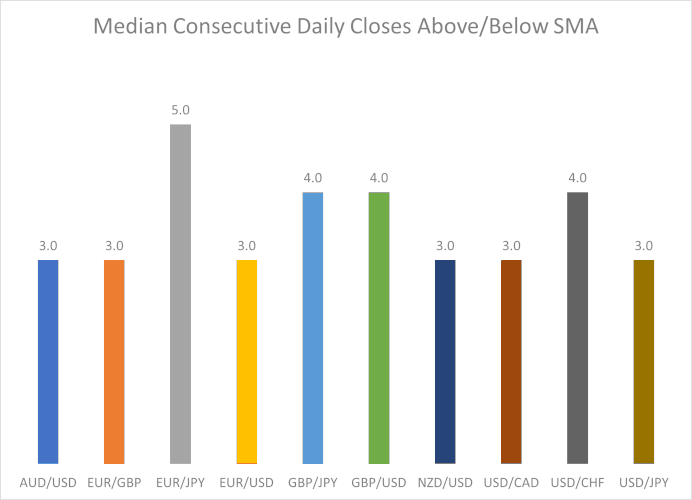
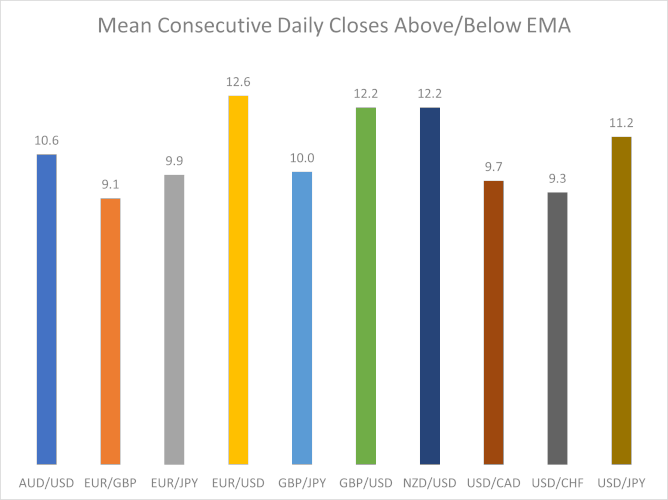
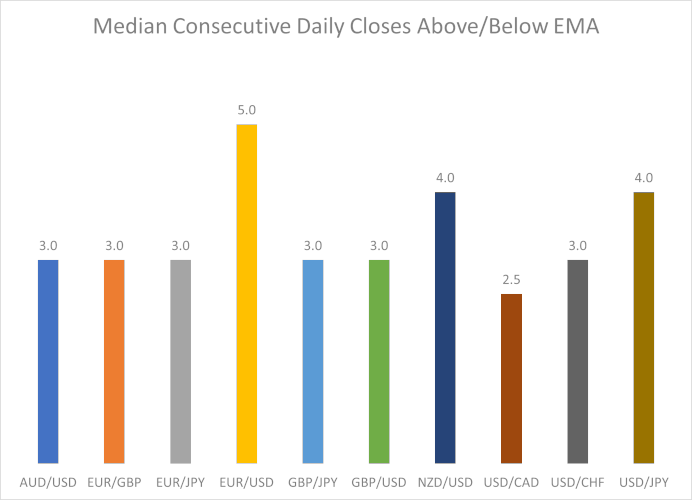
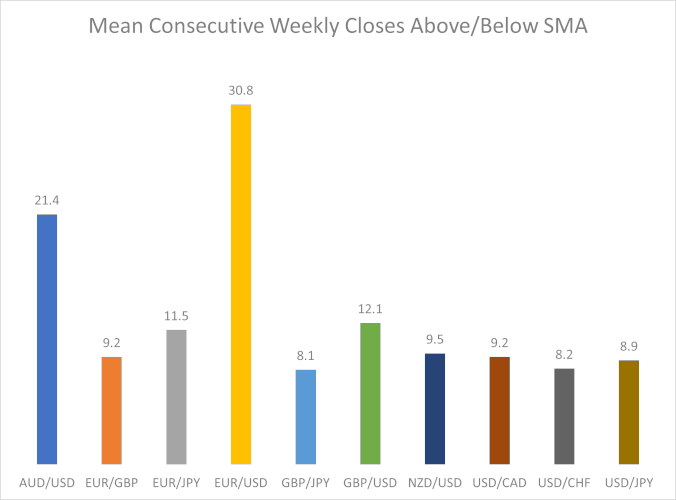
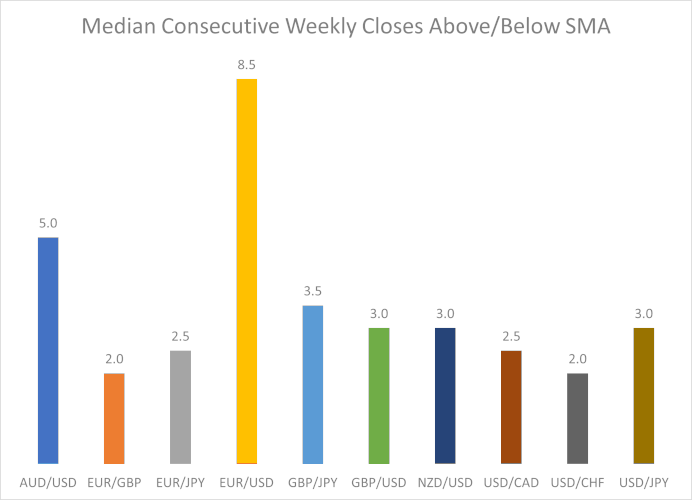
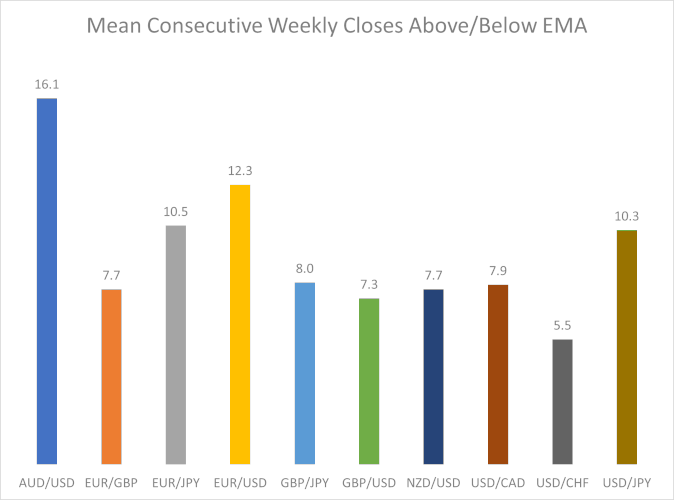
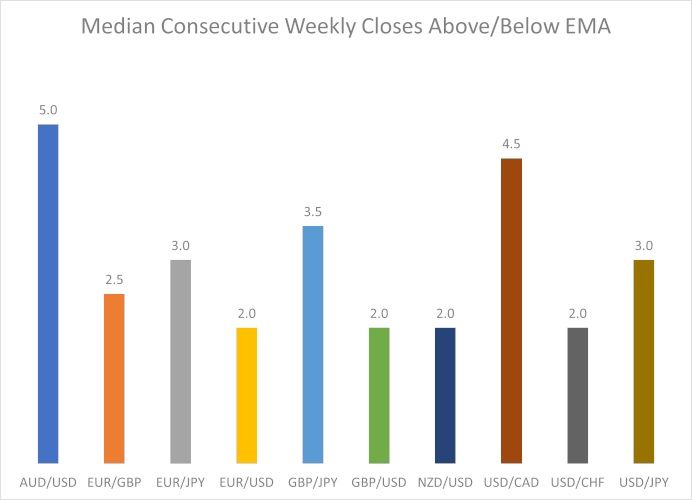
The table for the consecutive weeks above and below the moving averages is presented below.
| Weekly | ||||
| Currency pair | SMA | EMA | ||
| Mean | Median | Mean | Median | |
| AUD/USD | 13.1 | v.0 | thirteen.ix | eight.0 |
| EUR/GBP | 9.half-dozen | 3.0 | 10.5 | v.0 |
| EUR/JPY | 12.2 | 4.0 | 11.0 | 4.0 |
| EUR/USD | xiii.0 | 2.5 | 14.1 | ii.5 |
| GBP/JPY | 7.5 | 3.0 | 6.vi | iv.0 |
| GBP/USD | 13.three | 2.0 | 7.3 | 2.0 |
| NZD/USD | 9.five | 5.five | vii.5 | 2.0 |
| USD/CAD | 7.7 | two.0 | vi.8 | 4.5 |
| USD/CHF | 8.5 | 3.0 | 5.4 | ii.0 |
| USD/JPY | seven.i | 3.0 | viii.0 | 3.0 |
Rather surprisingly, each chart had its own winner on the weekly timeframe. GBP/USD came starting time with its xiii.iii mean value of above/below SMA periods, though AUD/USD and EUR/USD were close behind, with thirteen.1 and 13.0 respectively. NZD/USD was the winner in the median value, with its 5.5 upshot being noticeably higher up the next all-time 5.0 of AUD/USD. Turning to EMA, EUR/USD was the winner with the mean value of 14.1, though AUD/USD was not lagging far behind with xiii.9. And AUD/USD came out first in the median value of consecutive weekly closes above/below EMA, with its result 8.0 was above any other competitors. EUR/GBP took the second place but was far backside with its 5.0.
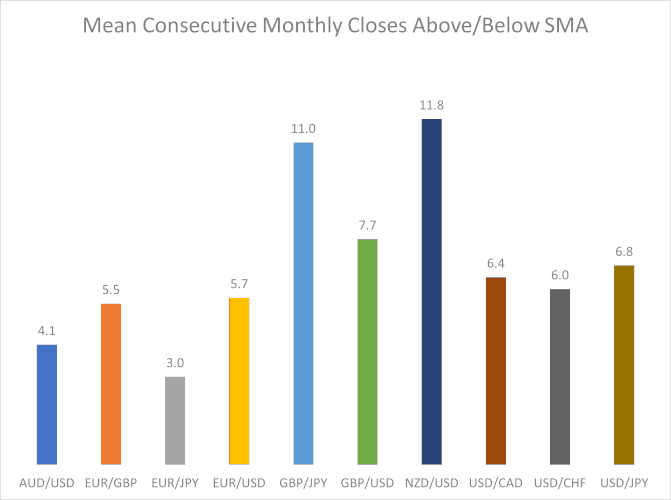
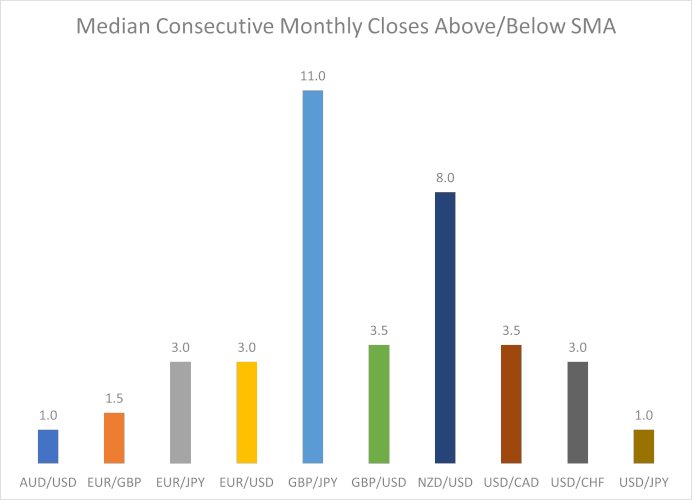
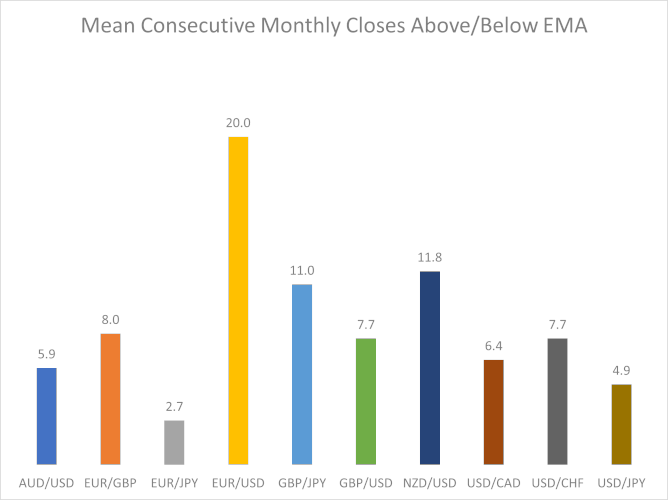
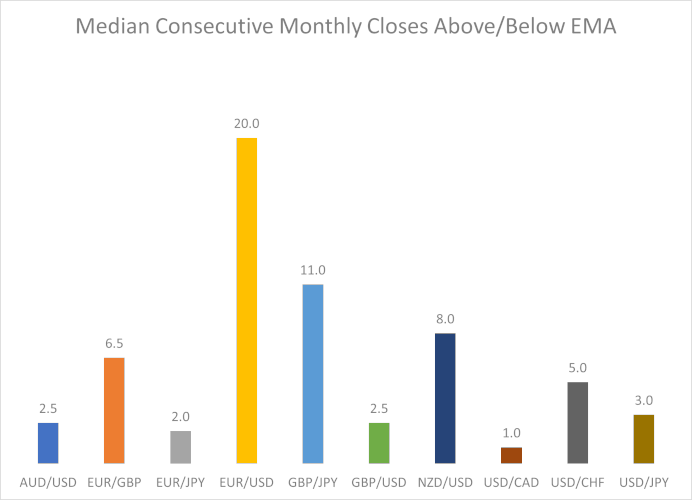
The table for the monthly data is presented below. Unfortunately, information technology doesn't offer reliable data considering 5 years contain not and so many monthly candles to work with.
| Monthly | ||||
| Currency pair | SMA | EMA | ||
| Mean | Median | Mean | Median | |
| AUD/USD | ten.4 | 2.0 | 10.iv | two.0 |
| EUR/GBP | 11.0 | 4.0 | 14.iii | 7.5 |
| EUR/JPY | 4.8 | 2.0 | 5.8 | 2.0 |
| EUR/USD | 5.3 | 3.0 | nine.6 | 6.0 |
| GBP/JPY | 54.0 | 54.0 | 18.0 | xviii.0 |
| GBP/USD | 10.4 | ii.0 | 10.4 | two.0 |
| NZD/USD | 10.4 | v.0 | 10.four | 5.0 |
| USD/CAD | v.eight | 2.0 | 10.4 | two.0 |
| USD/CHF | 5.nine | 4.0 | 4.6 | iv.0 |
| USD/JPY | six.2 | 4.0 | 5.1 | iii.0 |
Every bit you can see on the charts beneath, GBP/JPY gets an undeniable atomic number 82 but that's just because we only have 60 monthly candles to look at, and this currency pair spent almost all of them trending below or above the moving average. Still, the data can be useful to become the thought of how some pairs (I am looking at you lot, EUR/JPY) traded in a whipsawing sideways market place on a monthly timeframe. Another interesting point is that 3 pairs — GBP/USD, NZD/USD, and USD/CAD — show the same number of mean monthly closes in a higher place/below EMA — 10.4.
Higher High + Higher Low and Lower Low + Lower Loftier
A currency pair is generally believed to be trending if it forms consecutive Higher Highs with Higher Lows (HHHL) in an uptrend or Lower Depression with Lower Highs (LLLH) in a downtrend. Nosotros summate the mean number of HHHL and LLLH patterns for each currency pair on the daily, weekly, and monthly timeframes.
| Currency pair | Mean length of HHHL or LLLH streak | ||
| Daily | Weekly | Monthly | |
| AUD/USD | i.878 | one.796 | i.783 |
| EUR/GBP | 1.892 | one.816 | i.800 |
| EUR/JPY | 1.928 | 1.773 | 1.500 |
| EUR/USD | 1.960 | 1.650 | 2.263 |
| GBP/JPY | i.932 | ane.980 | one.407 |
| GBP/USD | 1.896 | 1.800 | ane.667 |
| NZD/USD | ane.902 | 1.746 | two.043 |
| USD/CAD | one.836 | 1.800 | 1.520 |
| USD/CHF | i.880 | 1.781 | 1.773 |
| USD/JPY | 1.964 | one.761 | 1.615 |
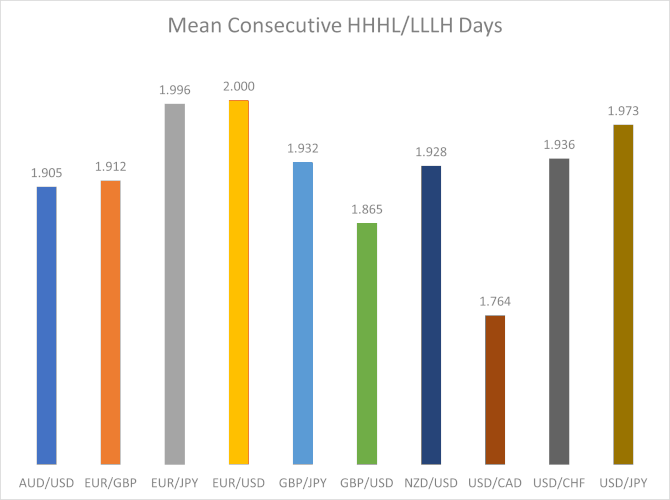
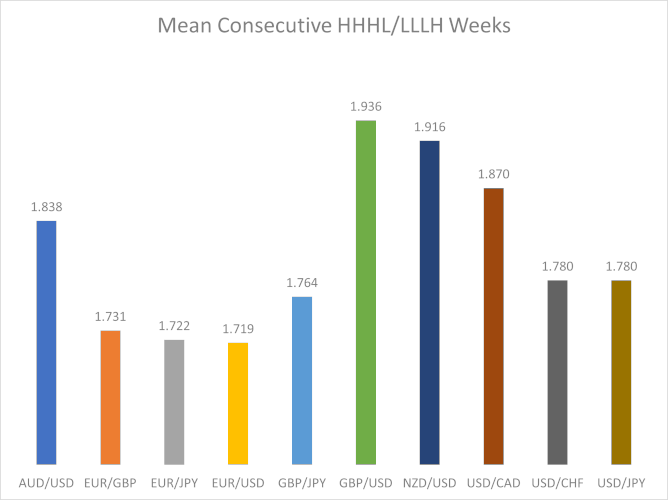
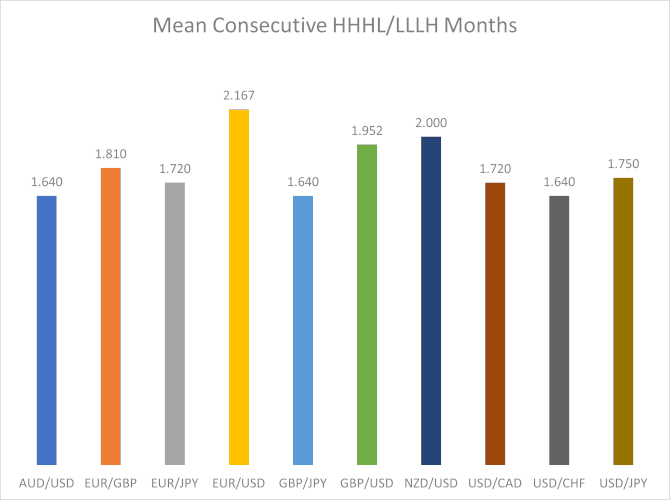
On the charts beneath, you lot can see the analogy of the data presented in the table in a higher place. Hateful sequent HHHL/LLLH days are the highest for USD/JPY and EUR/USD while being the lowest for USD/CAD. It is interesting to see that currency pairs were nearly at the same level on the weekly timeframe. Just two pairs deviated from the tendency noticeably - GBP/JPY to the upside and EUR/USD to the downside. It is extremely peculiar considering that the monthly chart shows the completely opposite result - EUR/USD demonstrates the highest number of consecutive HHHL/LLLH periods, whereas GBP/JPY has the lowest.
Consecutive bullish/bearish candles
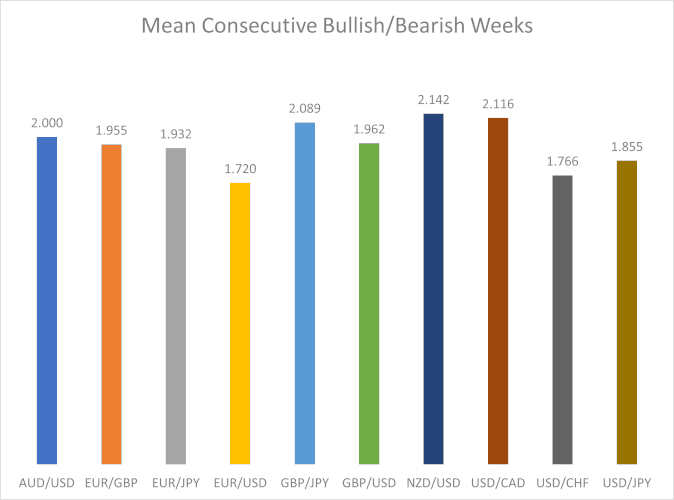
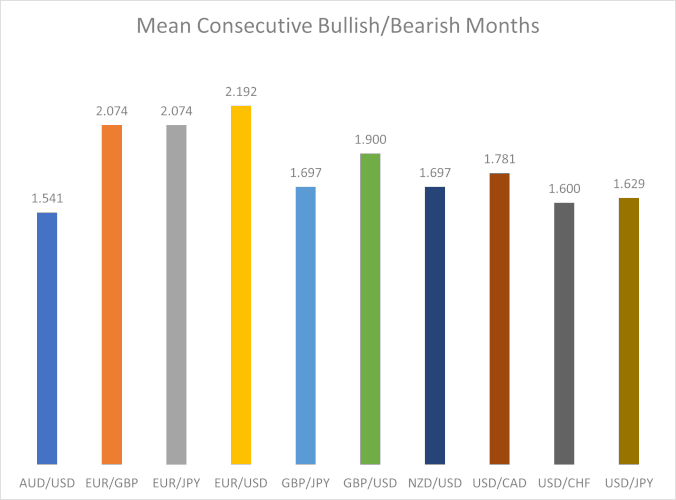
A blunter way to measure trends is to record the boilerplate number of consecutive bullish or surly candles. Information technology ignores the College Loftier + Loftier Depression and Lower Low + Lower High condition outlined in the previous analysis merely still captures useful information about the currency pair's trendedness. The following table contains the mean values of consecutive bullish/bearish candles for each currency pair on the daily, weekly, and monthly timeframes.
| Currency pair | Mean consecutive bullish/bearish candles | ||
| Daily | Weekly | Monthly | |
| AUD/USD | ane.989 | 2.031 | one.676 |
| EUR/GBP | 1.938 | one.954 | 2.375 |
| EUR/JPY | 2.079 | i.916 | 1.926 |
| EUR/USD | 1.903 | 1.732 | 2.036 |
| GBP/JPY | 1.966 | 2.151 | 1.676 |
| GBP/USD | 2.059 | i.904 | 1.727 |
| NZD/USD | 1.983 | 2.132 | 1.931 |
| USD/CAD | 1.907 | 1.895 | 2.037 |
| USD/CHF | one.983 | 1.760 | 1.647 |
| USD/JPY | 1.891 | ane.760 | one.583 |
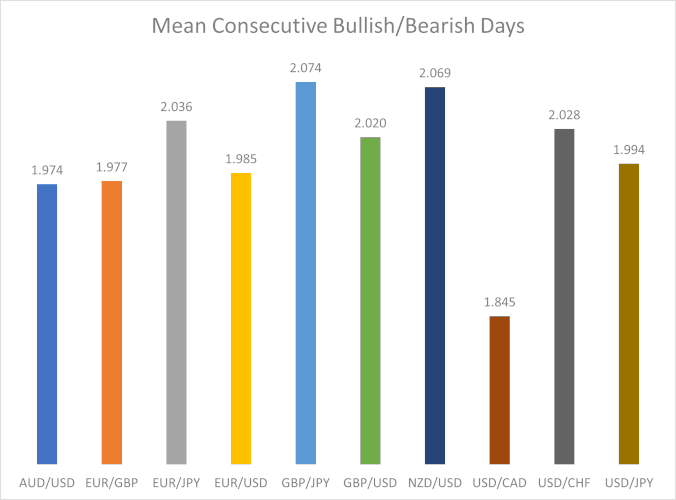
The main leaders on the daily timeframe are EUR/JPY and GBP/USD. The weekly timeframe favors GBP/JPY and NZD/USD. On the monthly charts, EUR/GBP is well alee of the rest of the crowd. These results don't stack well with the ones obtained in the assay by other methods. However information technology hints that average bullish and bearish streaks are quite longer at some currency pairs compared to others.
Conclusions
Our research has revealed the following facts based on the studied menstruum of v years:
- NZD/USD, GBP/JPY, and AUD/USD have the largest expected rate of change for any of the studied periods — twenty-four hours, week, and month. These should exist your currency pairs of option if your trading strategy involves opening a trade and belongings it for some stock-still period of fourth dimension.
- GBP/JPY and NZD/USD are the most volatile pairs. Information technology ways that an average candle on these pairs' charts is likely to be longer than on the charts of other currency pairs. This can be used to capture large movements (spikes) with
well-placed take-profit orders. This determination (along with the one to a higher place) also seems to be very reliable every bit the currency pairs pb not only past mean but also the median values. - NZD/USD, GBP/JPY, and AUD/USD are the best trending pairs when measuring trends with a moving average on a daily timeframe.
- AUD/USD, GBP/USD, EUR/USD, and NZD/USD enter longer trends on boilerplate on a weekly timeframe.
- Monthly timeframe comparison to moving averages is highly unreliable, so there is lilliputian indicate in trying to get any insights from GBP/JPY and EUR/GBP dominance in that location.
- The information on consecutive Higher High + Higher Depression or Lower Low + Lower High is very mixed with no articulate leaders (especially on weekly timeframe).
- Consecutive bullish/bearish candles data is also very mixed merely suggests that trading in GBP/USD, EUR/JPY, NZD/USD, EUR/GBP, and GBP/JPY on a daily timeframe can be more lucrative if your strategy relies on candles repeating their color.
Additionally:
- The higher volatility on GBP/JPY, NZD/USD, and AUD/USD also warrants a wider
stop-loss for your trades. - The low median number of days in a higher place/beneath a moving average for most currency pairs (just three or 4 days) suggests that the basic moving average crossover strategy is ineffective with nearly trading instruments. Whether expecting the high median values to agree for pairs that had them loftier during the previous 5 years is a good idea is some other (unanswered) question.
- If you were to answer the question of what is the most trending currency pair based on all the data in this guide, it would make sense to say that information technology is either GBP/JPY or NZD/USD. However, it should exist noted that the latter unremarkably involves lower spreads.
Important note: Past functioning is non an indication of future performance. This means that it might exist impractical to base actual trading on expectations of the trending behavior to remain the aforementioned equally they were during the studied catamenia.
Script
And at present to the most important stuff — a MetaTrader script that can exist used to get the aforementioned data that is presented in this guide and fifty-fifty more than. TrendStats script consists of ii files that should be unarchived into the same subfolder within your /MQL4/Scripts/ binder (/MQL5/Scripts/ for MetaTrader v). Y'all demand to compile TrendStats.mq4 (for MetaTrader iv) or TrendStats.mq5 (for MetaTrader five); TrendsStats.mqh is an include file used by TrendStats.mq4 and TrendStats.mq5.
The script, when run on whatever nautical chart, volition clarify a list of currency pairs (given via input parameters) on a range of timeframes (too given via input parameters) and on a given time menses (too child-bearing via input parameters). Information technology will produce .csv files with output results and will also output the results in theExperts tab of the last. Hither is the list of input parameters for the script:
- Symbols — a list of currency pairs and other trading instruments you lot want to analyze. Enter them as they are listed in your Market place Watch window. You tin can apply space, comma, or semicolon to carve up them.
- Timeframes — a list of timeframes to process. Enter them as
M1,H4, orPERIOD_M1,PERIOD_H4, and so on. Same as with Symbols, recognized separators are space, comma, and semicolon. - PeriodToProcess — a menstruum to process by the script. It is a choice of either
Last_5_Years(same as was used in this guide),Time_Period(you and so set up the exact start and finish dates via StartDate andFinishDate inputs), andLast_N_Candles (you then set up the exact number of candles to process via N input parameter). - StartDate — ignored unless
Time_Periodis selected inPeriodToProcess. - FinishDate — ignored unless
Time_Periodis selected inPeriodToProcess. - N — ignored unless
Last_N_Candlesis selected inPeriodToProcess. - Time_Shift — you can ready the time shift in hours to movement the start of the date. This is useful if your broker has an unconventional time zone. For case, if your server is UTC-7 and you want the day to start exactly at 00:00 UTC, yous set this parameter to 7. Delight note, that setting
non-zero Time_Shift will make the script calculate everything using H1 data but — it will be converted to other timeframes you request via the Timeframes parameter, just at that place might be not enough H1 candles to generate plentyhigh-timeframe data. - MA_Period — a moving boilerplate period for moving average comparison stats.
- FileNamePrefix — a prefix for .csv file names.
- SilentMode — if true, the silent mode will prevent the script from outputting any calculation data into the Experts tab of the final. Service and error messages will nonetheless be printed.
Downloads:
- TrendStats for MetaTrader iv
- TrendStats for MetaTrader 5
If you have some questions about this study of the major currency pairs' trendedness, if you want to suggest some other measures of trendedness to clarify, or if y'all discover some bugs in the TrendStats script, please proceed to our Forex forum.
If y'all desire to get news of the nigh recent updates to our guides or annihilation else related to Forex trading, you tin subscribe to our monthly newsletter.
Forex trading bears intrinsic risks of loss. Yous must sympathise that Forex trading, while potentially profitable, can make you lose your coin. Never trade with the money that you lot cannot afford to lose! Trading with leverage can wipe your account even faster.
CFDs are leveraged products and as such loses may be more than than the initial invested capital. Trading in CFDs carry a high level of risk thus may not be appropriate for all investors.

Forex Pairs That Trend Best,
Source: https://www.earnforex.com/guides/which-forex-pair-trends-the-most/
Posted by: bourgeoisbehiden.blogspot.com
0 Response to "Forex Pairs That Trend Best"
Post a Comment